Research summary
Multi-Modal Open Surveillance with AI-Driven Calibrated Inference
MOSAIC fuses three public, authentication-free surveillance streams, CDC NWSS wastewater, Nextstrain genomics, and WHO DON / ProMED outbreak text, into one calibrated quantity: P(Rt > 1), the probability that transmission is currently growing. The paper gives the full probabilistic model (renewal latent incidence with negative-binomial, Poisson, and Dirichlet-multinomial observation kernels; Poisson-Gamma BOCPD; Jensen-Shannon genomic anomaly; EpiEstim Rt; a noisy-or fusion that reduces to a hierarchical NUTS posterior) and then evaluates the deployed system on real data. Every figure below is computed from real public data, nothing is synthetic.
0.086
Expected Calibration Error
ECE < 0.10 ⇒ well-calibrated
0.917
AUROC
strong growth discrimination
0.124
Brier score
= 0.010 − 0.136 + 0.250
1,334
day-ahead forecasts
real CDC NWSS record, 2021-2025
68 d
median lead
P(Rt>1)>0.5 before wave peak
1· The stated probability is calibrated and discriminative
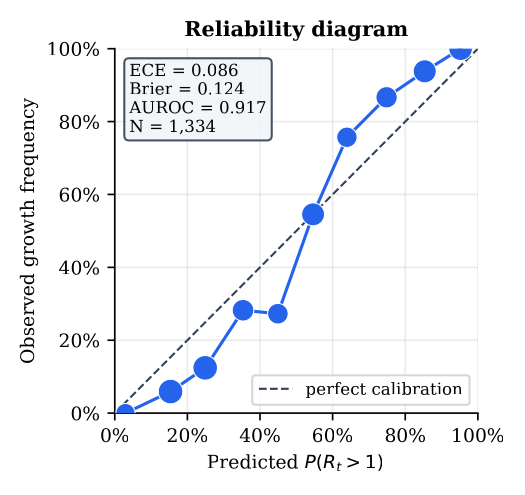
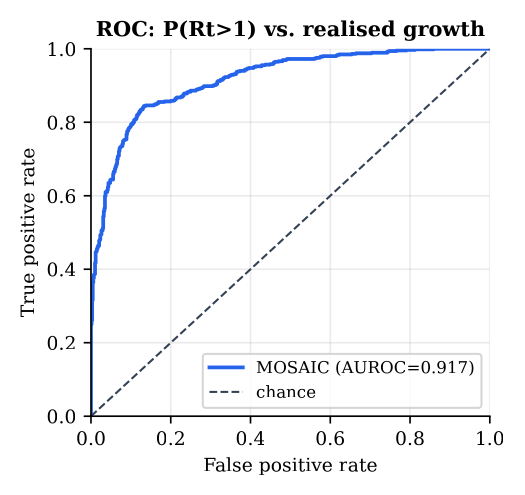
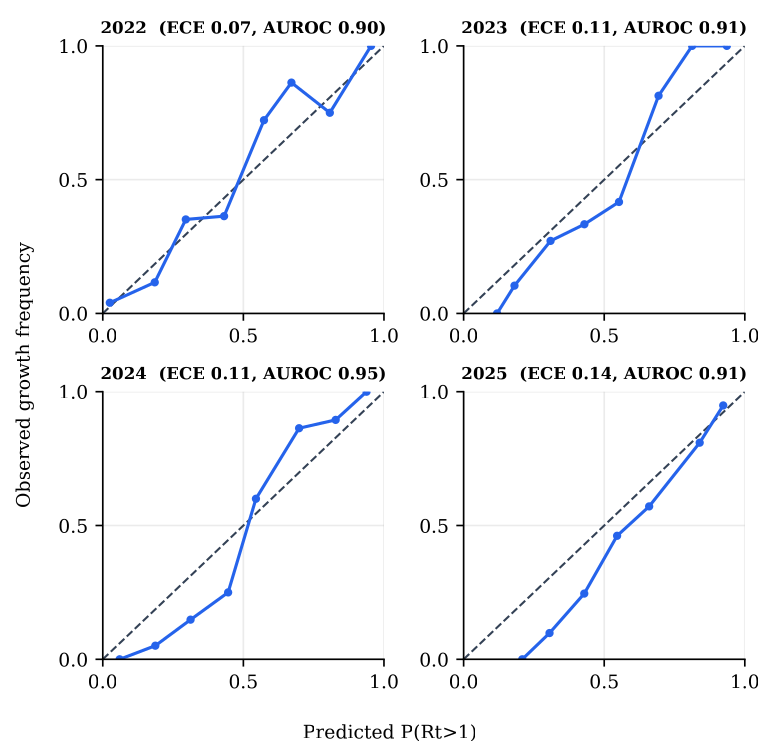
I treat P(Rt > 1) as a probabilistic forecast and ask whether it matches reality. At each day I compute the EpiEstim renewal posterior from data up to that day and check whether wastewater activity actually rose over the following 14 days, a strictly prospective test with no leakage. Across 1,334 day-ahead forecasts on the multi-year national NWSS record the reliability curve hugs the diagonal (ECE 0.086) and the forecast is strongly discriminative (AUROC 0.917). A Murphy decomposition of the Brier score, 0.124 = reliability 0.010 − resolution 0.136 + uncertainty 0.250, confirms both: a tiny reliability term (good calibration) and a large resolution term (the forecasts carry real information about which days grow).
Concretely: when MOSAIC says 75%, activity rises about 87% of the time; when it says 15%, about 6%. That is the empirical meaning of the percentage shown on the dashboard, and it is what lets a user pick an alert threshold and know what it means, which an uncalibrated score cannot support.
2· It is a leading indicator: ~68 days before the wave peak
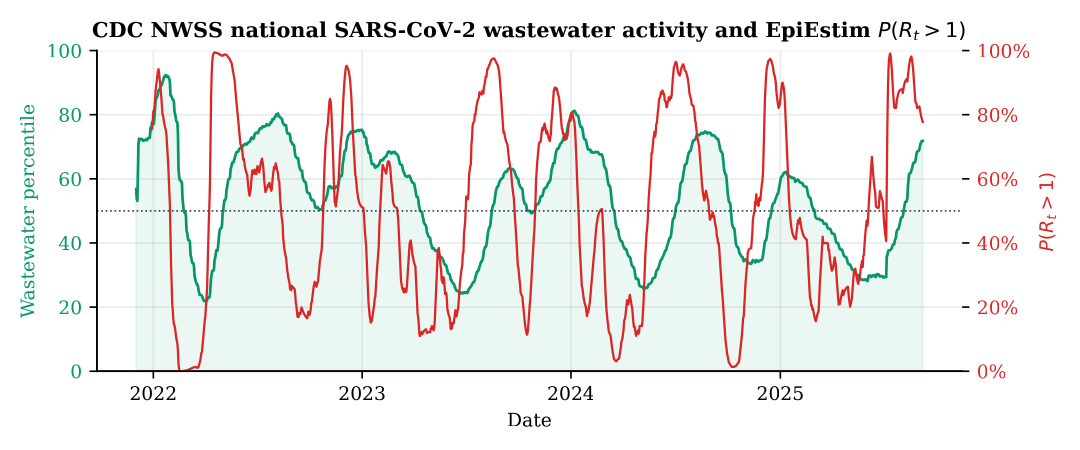
Because P(Rt > 1) is a derivative-like signal, it turns at the onset of a wave, long before the level peaks. Detecting national wave peaks and finding the last upward crossing of P(Rt>1) through 50% before each, the growth probability leads the peak by a median of 68 days (mean 73, IQR 67-77). Wastewater is a near-real-time census of community prevalence, shedding starts early and is independent of testing behaviour, and the renewal estimator converts that level into a statement about its slope, crossing 50% before each NWSS wave peaks and dropping below it before each decline.
3· The result is robust, across horizons, years, and serial intervals
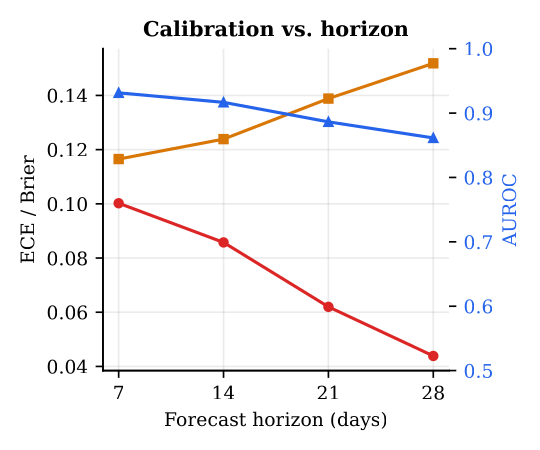
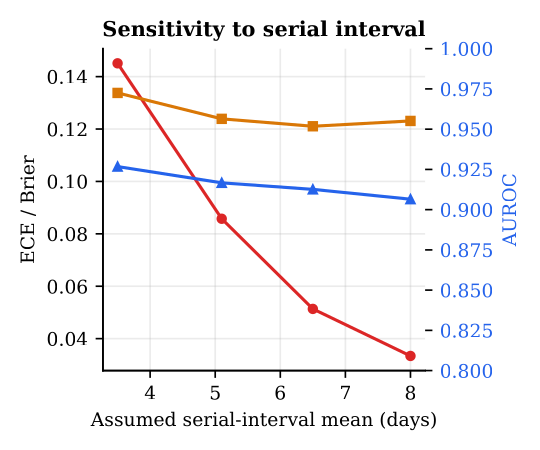
The calibration is not an artefact of one favourable choice. Sweeping the forecast horizon (7-28 days) reveals a clean trade-off: longer horizons are easier to calibrate (ECE 0.100→0.044) but harder to discriminate (AUROC 0.931→0.861), with 14 days near the knee. Computing the metrics per calendar year (2022-2025), the ECE stays in 0.069-0.145 and AUROC in 0.900-0.947 across the Delta, Omicron, and post-Omicron eras. And varying the assumed serial interval (3.5-8 days) leaves discrimination essentially invariant while shifting calibration smoothly, the literature value (5.1 d) sits in the well-calibrated middle.
4· Fusion surfaces concurrent outbreaks with per-stream attribution
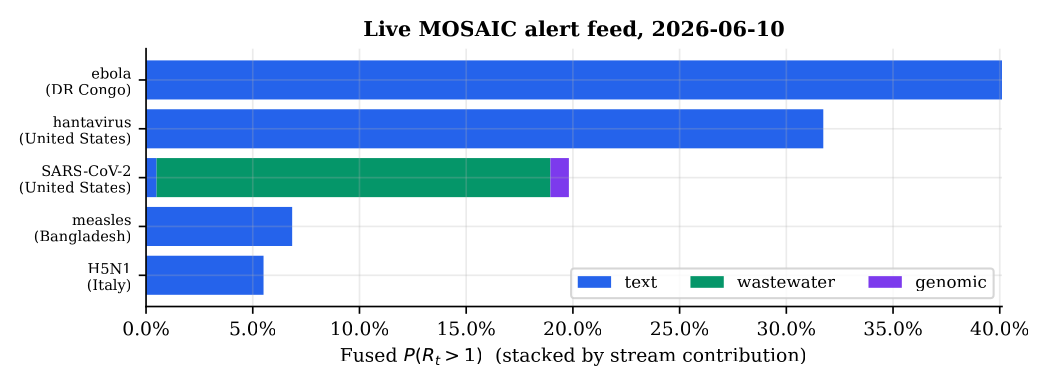
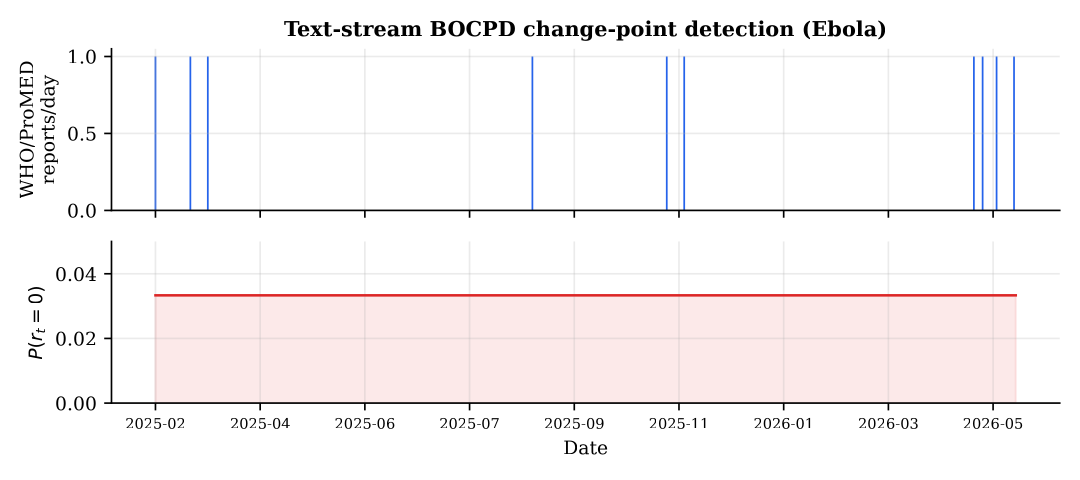
The independent-evidence (noisy-or) fusion renormalizes weights over the streams that actually carry data for a pathogen, so a text-only outbreak (a filovirus with no wastewater or genomic panel) is not diluted by absent streams. On the live feed the system ranks concurrent real outbreaks, Bundibugyo ebolavirus (DR Congo, Uganda, Sudan), hantavirus clusters, an elevated U.S. SARS-CoV-2 wastewater wave, measles, avian influenza, and lists the specific countries each touches, attributing each alert to its driving stream. The SARS-CoV-2 alert is wastewater-driven; the rest are text-driven, and BOCPD on the report stream spikes when clustered reports follow a quiet period.
5· Genomic anomaly tracks real variant turnover
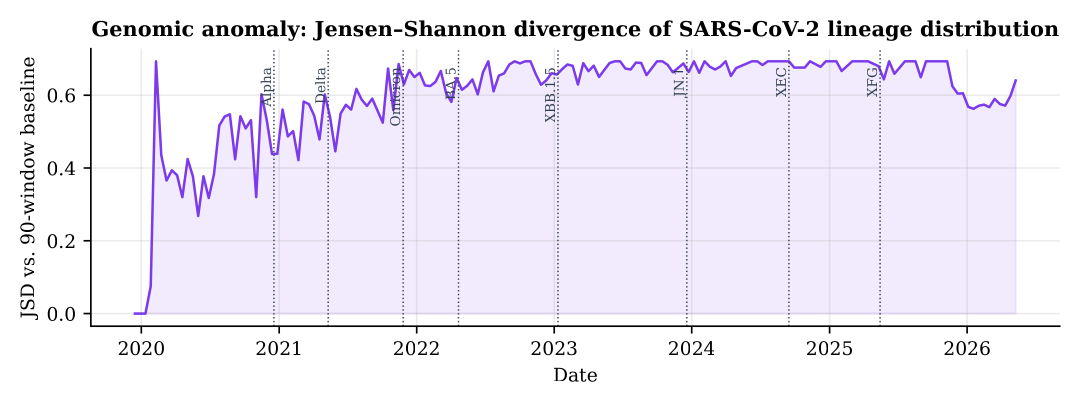
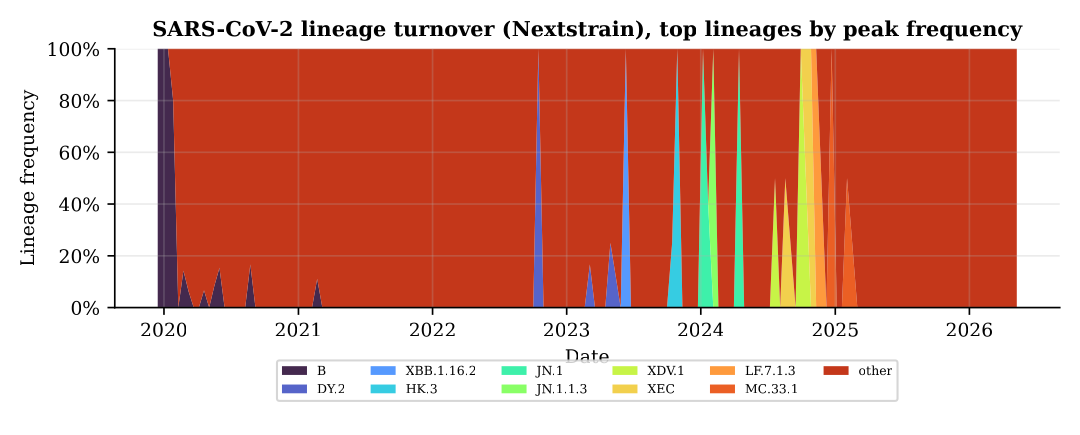
The Jensen-Shannon divergence of the SARS-CoV-2 lineage distribution against a rolling baseline rises during documented antigenic transitions (the Omicron sweep, BA.5, XBB, JN.1) and is quiescent when composition is stable. The genomic stream is highly informative about antigenic change but, unlike wastewater, its alarm is not on its own a calibrated probability of growth, which is exactly why the multi-modal design is warranted and why I calibrate on wastewater and treat genomics as corroborating evidence. A pre-computation fix reduces the detector from O(T²K²), billions of operations that timed out on serverless infrastructure, to O(TBK) (~20 ms).
6· Forecasting, and a numerical correction worth flagging
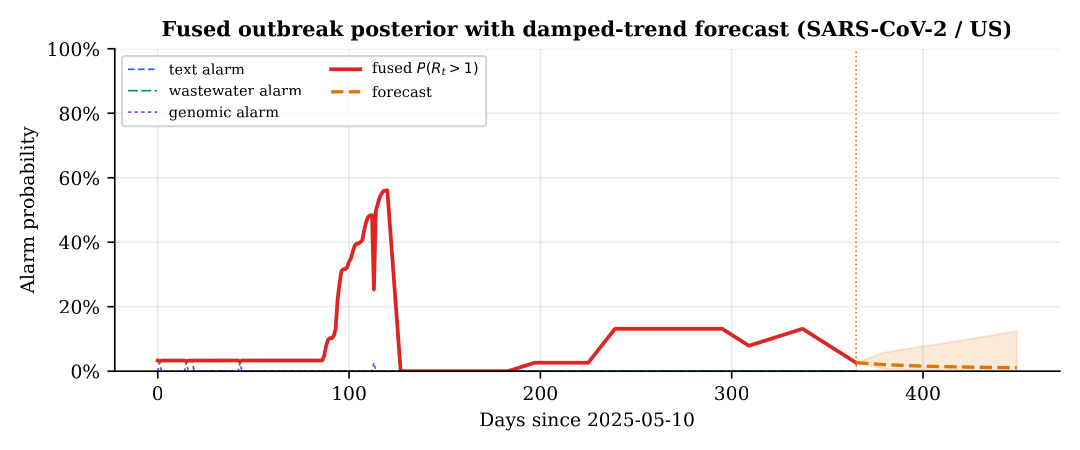
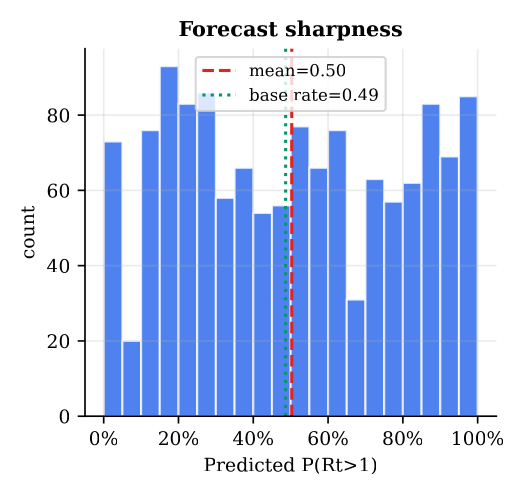
A damped-trend logit-space projection extends the fused posterior forward with a √h-widening 95% band, a deliberately conservative, mean-reverting baseline. Separately, building the backend-free tier surfaced a numerical pitfall worth flagging: the reproduction-number tail probability P(Rt > 1) silently returns wrong values for large-count series when the regularized incomplete-gamma expansion is truncated, it can invert the sign of the estimate. A Wilson-Hilferty normal branch for large posterior shape restores correctness (and reproduces a SciPy reference to three decimals). The sharpness histogram below shows the forecasts are bimodal and their mean matches the base rate.
7· Causal inference: interventions, counterfactuals, and confounding
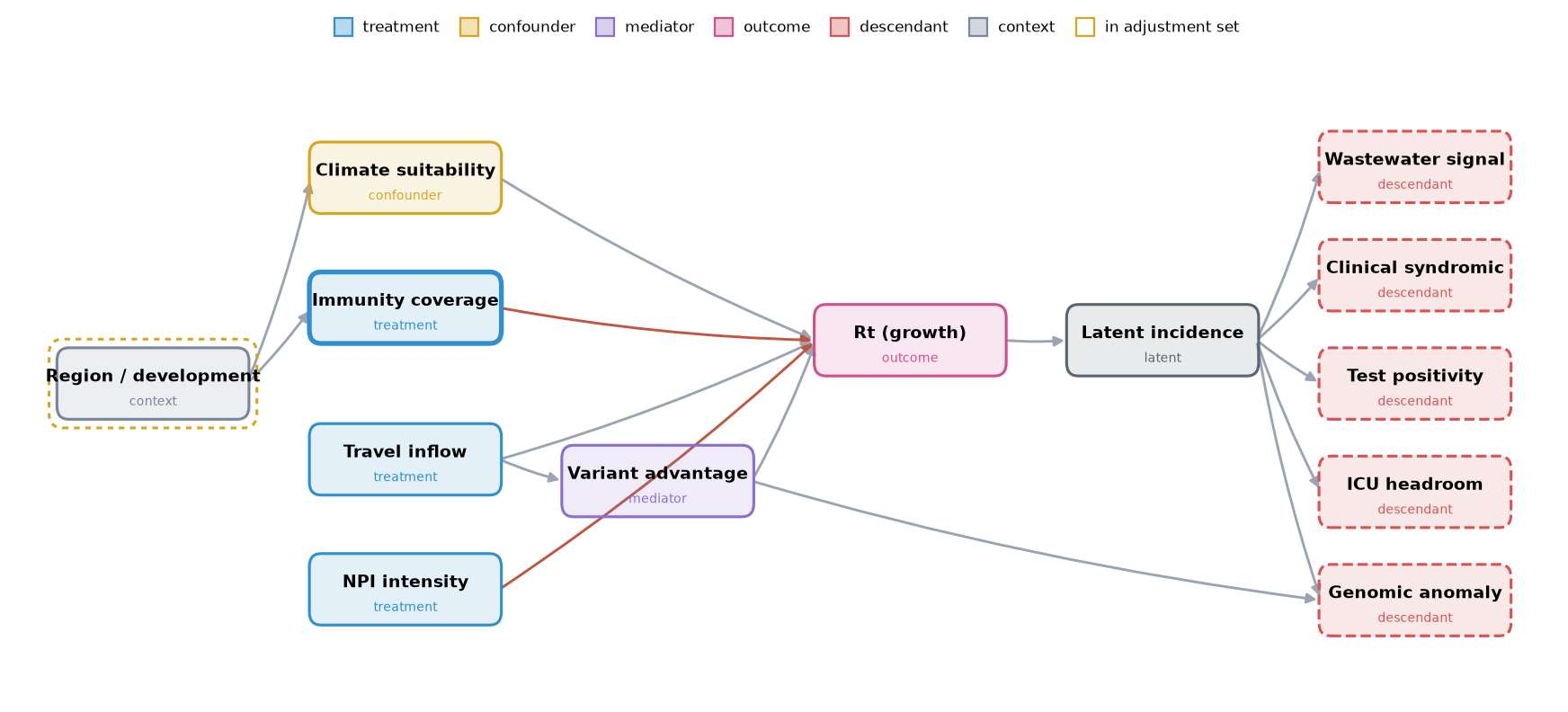
Calibration tells you the probability is trustworthy; it does not tell you what would happen if you acted. The causal layer adds an explicit directed acyclic graph over the drivers and a structural causal model on top of the renewal equation, so the console can answer interventional and counterfactual questions. It is honest about what it is: no interventional ground truth exists in open surveillance data, so the graph and coefficients are stated assumptions, shown to the user, and every effect is model-implied. The one real anchor is each site's observed P(Rt > 1), which the counterfactual reproduces exactly at the null intervention.
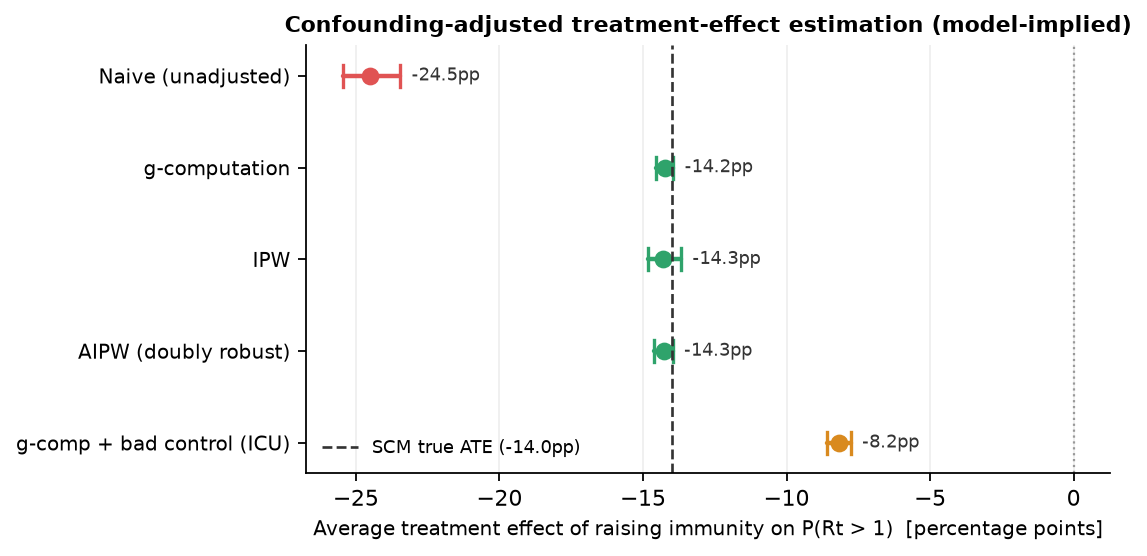
The graph makes the identification explicit. `climate`, `immunity`, and `mobility` are upstream causes; `clinical`, `positivity`, `ICU headroom`, wastewater, and the genomic anomaly are descendants of latent incidence, which makes them bad controls. Estimating the effect of raising immunity across the cohort, the naive contrast is biased by region and climate, while g-computation, IPW, and doubly-robust AIPW recover the true effect after backdoor adjustment. Adding a descendant of the outcome (ICU headroom) to the adjustment set visibly reintroduces bias, the textbook bad-control failure, demonstrated live rather than asserted.
Methods, in brief
- Renewal core: latent incidence It = Rt·Σ ws It−s; EpiEstim Poisson-Gamma posterior on Rt; P(Rt>1) via the Gamma tail with a Wilson-Hilferty branch at large shape.
- Wastewater (NegBin): server-side national percentile aggregation; BOCPD change-point with a windowed-maximum alarm + sustained-elevation noisy-or.
- Text (Poisson): WHO DON / ProMED extraction with multi-country ISO resolution; BOCPD on dense daily counts with recency/intensity weighting.
- Genomic (Dirichlet-multinomial): Jensen-Shannon divergence anomaly vs. a 90-window baseline (bounded, symmetric, finite on sparse data).
- Fusion: weighted logarithmic / noisy-or pool over present streams; full hierarchical NumPyro / NUTS posterior in the backend.
- Causal: explicit DAG with d-separation and backdoor identification; assumed structural causal model for do() / counterfactuals / potential outcomes; ATE via g-computation, IPW, and doubly-robust AIPW, validated against a known-truth simulation.
The reliability diagram validates the lightweight EpiEstim estimator served by the live deployment; the full multi-stream NumPyro calibration is produced by the Python backend. See the full paper for derivations, algorithm boxes, and all tables.